01 / The detail
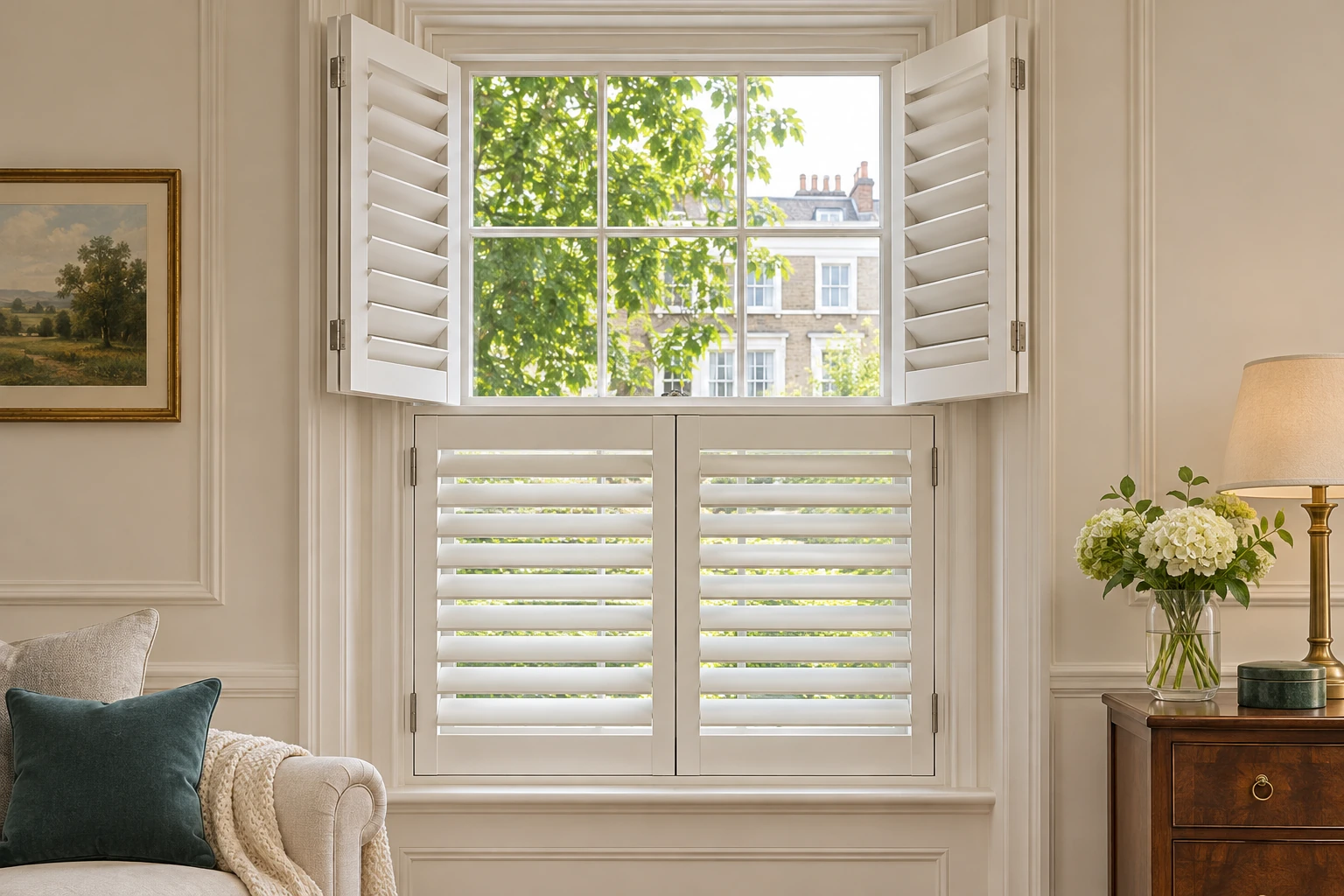
Choose two tiers because you will use them
Independent panel opening is useful when you regularly want clear upper glass. If you mainly want a different light level above and below, a full-height shutter with suitable split louvre control may be enough. We compare those functions so the additional horizontal join has a practical purpose.
Consider the room at different times. A seating area may need lower-level privacy during the day and full coverage after dark. Your habits help establish whether both tiers will often open, whether one stays closed, and which handles need to remain within reach.
02 / The detail
Position the join with the whole elevation in mind
The two sets of panels introduce a clear horizontal line. Its relationship to a sash meeting rail or another glazing feature affects the proportions. On a short window, two tiers may leave comparatively small louvred areas, so we look at the complete layout before recommending the style.
Where several windows sit together, matching the split requires thought about floor levels and different opening heights. The agreed design identifies the dividing line and panel arrangement for each window. Material and size restrictions are checked for the selected shutter range.
03 / The detail
Allow a separate movement path for each set
The top panels need space beside the upper window, while the lower panels may meet a sill, radiator or furniture. A curtain hanging in front can obstruct one or both sets. We assess these paths with the window open too, especially where the glazing tilts or opens into the room.
At installation we check the alignment of the tiers and demonstrate the intended opening sequence. You can then use the louvres for fine adjustment and the panels for wider access. Gentle handling of each set helps avoid pulling against neighbouring panels or hinges.